By Elliot Denton
Content Warnings: Suicide, struggling with mental health in lockdown, grief
This day is important every year.
The 10th September is Suicide Prevention Day, a day where we remember all those who have taken their own lives and ways which we can prevent suicide. This piece is dedicated to all those people, and to that day which has inspired me to talk about a topic that has affected my life and so many others. I am no expert and my writing style is nowhere near perfect, therefore apologies if I tread on eggshells. Education is a powerful tool, and that is the purpose of this post. The Office for National Statistics reports that every 40 seconds someone takes their own life, so whilst it was a topic that I was reluctant to talk about at first, it was not one I could ignore.
For me personally I am fortunate enough to be able to say that I have not been significantly affected by suicide. I have dealt with mental health issues such as anxiety and depression, but I have never seriously contemplated taking my own life. Around two years ago my hairdresser took their own life. She had cut mine and my Dad’s hair for a number of years, she had a partner, she had a young child and she brought so much happiness to the workplace. The news was devastating and such a shock. If I’m honest, I didn’t 100% understand. I fell into that trap of “she was so happy”, and “how did that happen”. It made me realise that you never truly know what is going on in someone’s life, behind someone’s smile or laughter. Unfortunately, like with many suicides, you only know they were struggling when it’s too late.
As a young man I am aware that this is simultaneously something my male friends and I are less likely to talk about, and is something that is more likely to affect us. Suicide is the single biggest killer of men aged under 45 in the UK. Something that shocked me and that I was not made aware of until researching this topic is that women are more likely to be diagnosed with depression and attempt suicide than men, but men make up around 75% of suicide deaths. The BBC wrote a really insightful article about why more men commit suicide, which informed a lot of my thinking and writing here. This disparity is largely attributed to method, which is a factor not commonly known about. What is more commonly acknowledged is that men are less likely to express how they feel compared to women. The patriarchy and toxic masculinity ensures that from a young age men are conditioned to be tough, strong, and not to show weakness, which in this case would be emotions. Fortunately, times are beginning to change, with many great campaigns and charities becoming increasingly popular. However, there is still a long way to go.
“Men seek help for mental health less often,” Harkavy-Friedman (vice-president of research for the American Foundation for Suicide Prevention) says. “It’s not that men don’t have the same issues as women – but they’re a little less likely to know they have whatever stresses or mental health conditions that are putting them at greater risk for suicide.”
If possible, it feels even more important to talk about Suicide Prevention this year.
Tragically, suicide rates are increasing, and this seems closely linked to COVID-19. It is hard to obtain specific facts and figures from the office for national statistics, but it does seem certain they will be worryingly high. Of course, every person has their own story but experts have identified common themes in suicidal behaviour, and it seems COVID and the situation around it have had a hugely negative impact. For example, an increase in isolation from support networks, collective and individual trauma, difficulties accessing and receiving care throughout this period, an increase in poverty levels, and major societal change.
What should we do?
It is important to recognise we all have different levels of responsibility here, and to break it down as such: What should society do to prevent suicide, what should we do to prevent suicide, and if you are someone who is struggling, what support is available.
Society: In light of the Covid-19 pandemic and its impact on mental health, I think authorities have to take action and responsibility. It’s very naïve for our Prime Minister and the government to ignore the mental health crisis that is currently taking place. I have watched all of Boris Johnson’s addresses to the public and there hasn’t been a single mention of mental health and possible support. Millions are suffering and as discussed above suicide rates will increase. It’s so difficult to get support for mental health related issues as it’s almost impossible to see a professional in person. Charities have been overwhelmed with the amount of people asking for support and it’s time that the government has to step in. Instead of further cuts to mental health support, at least take responsibility and address the issue directly. I do not have all the answers, but I know that more can be done. Fund those organisations that are trying to help so they can increase their outreach, implement mental health awareness into the education system and get rid of the bullshit stigma around mental health. Education is fundamental and don’t get me wrong, it’s all well and good sending thoughts and prayers, but structural changes, funding, and action are the only things that will diminish this crisis.
As an Individual: There is a balance to be had. On the one hand, you can have a real impact! Just ask anyone you know how they are; it does the world of good for someone’s day if someone drops in on them. You never know what dark place someone could be in, but once they see that message from you asking how they are and letting them know you’re thinking of them, it could make their day. This creates a really positive culture and can be really easy to do. This culture may mean that a struggling friend feels able to come to you, or that you catch them on a bad day, the kind of support that can be invaluable.
However, you are a friend not a professional. If you are unsure on how to help someone, maybe do a bit of research, websites such as Mind, NHS and Samaritans are really good on explaining mental health and possible ways you can help. But please know your limits, once someone is in that dark place, it is extremely hard to get out of it immediately. Try not to put too much pressure on yourself, it is devastating when a friend or family member is struggling; the effects can be life-long and but professional help is always available, even at times like this. Below are some good places to start with signposting.
If you are having suicidal thoughts, or if you are looking to sign post someone who is:
Remember, you are not alone, it is okay, and so many people care, way more than you think. There are some great charities here that offer 24/7 support and are not just some robot, real people with real feelings and do want to help. Here are some:
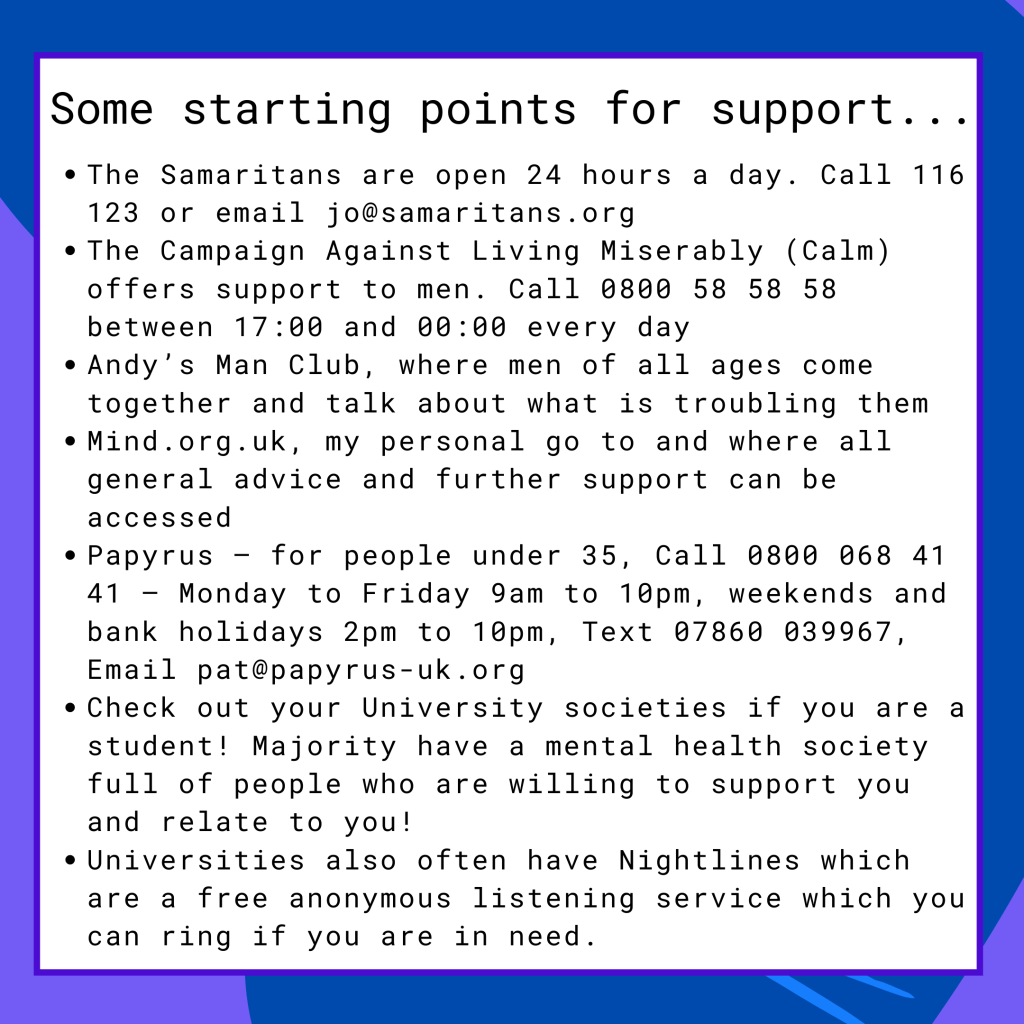
- The Samaritans are open 24 hours a day. Call 116 123 or email jo@samaritans.org
- The Campaign Against Living Miserably (Calm) offers support to men. Call 0800 58 58 58 between 17:00 and 00:00 every day
- Andy’s Man Club, where men of all ages come together and talk about what is troubling them
- Mind.org.uk, my personal go to and where all general advice and further support can be accessed
- Papyrus – for people under 35, Call 0800 068 41 41 – Monday to Friday 9am to 10pm, weekends and bank holidays 2pm to 10pm, Text 07860 039967, Email pat@papyrus-uk.org
- Check out your University societies if you are a student! Majority have a mental health society full of people who are willing to support you and relate to you!
- Universities also often have Nightlines which are a free anonymous listening service which you can ring if you are in need.
Suicide Prevention Day is a much-needed day that raises so much awareness for a topic that is devastatingly prevalent. However, because of this these kinds of conversations need to be every day, not just September 10th. Even more this year does it feel important that we really sit up, take notice, and be part of suicide prevention. So, please let this piece of writing be the beginning of being part of the solution. Whether that is conversations with your friends where you ask how they are, or educating and advocating for suicide prevention, or taking time out to focus on your mental health and wellbeing.

 The LUNA Project Blog